Never having been to a Library Camp before, I was very excited to hear about Library Camp East and I put my name down faster than I could roll out my camping mat and get the billycans on the stove. But even when I realised it wasn't that sort of camping, I was really excited and also a little nervous to see how an unconference would work in reality.
The day came when I was very kindly collected from Cambridge train station and given a lift out to Harlow. I'll admit, as we approached Harlow College, I nervously anticipated what the day would be like. Would we be doing trust exercises on the lawn? Building our own issue desks out of macrame? Turns out, it was not a bit like that. Not at all.
I had the most liberated networking experience during that Saturday in Harlow. It was liberated precisely because it was not confined to the usual codes and etiquettes of conferences. Now I'm not saying that Library Camps are a substitute for full organised conferences; in fact, the good thing about conferences proper is the level of research being shared. Having returned just last month from IFLA's WLIC2013, I can state with confidence how important it is to have the opportunity to attend professional conferences with formal research presentations. However, Library Camps act in my opinion as the companions of formal conferences, the invaluable less formal setting where hierarchies leave the building and we can share ideas on a flat level structure.
And flat level it certainly was! It was liberating in the extreme to walk into the main hall and sit on the floor with information professionals at all levels of their careers. People then pitched their session ideas and we could just informally choose which ones to attend. Something that I've never been able to do is to walk out of a session if it doesn't work for me and go to another one, but we were encouraged to do this to get the most out of the day. The first session I chose was about creative CPD on a low budget which was really interesting and I got some useful tips including webinars and MOOCs. I then went to a session on fines where we considered whether or not we should even charge them. Debating with very senior people within a flat non-hierarchical environment was refreshing and liberating.
A big thank you to everyone who brought food for the lunch table; it was amazing. And my savoury muffins seemed to go down well as well!
After lunch, I couldn't decide which session to go to and ended up in an inspired write-in with several of my fellow librarian writers. Having the time to plan out my novel was great and having the chance to share my ideas in a supportive atmosphere was invaluable. I always find it hard to talk about my writing, so thank you Rachel for making this possible.
My final session was about silence. Librarians have a funny relationship with silence, often being accused of liking it too much by the public and yet needing to uphold it in certain circumstances in order to facilitate learning within a space. To confront this relationship head-on, we had a positive experience with silence as we sat in a silent room. For 45 minutes, I sat and watched the trees moving in the breeze, sunlight dappling their leaves. The funny thing about silence is that the more you listen, the noisier it gets. I started to hear the traffic swishing on the main roads in town; I jumped when a crow cawed overhead. After almost an hour, I felt relaxed and rested, and it made me realise that we need to make time in this hectic world just to be.
Library Camp for me was a wonderful developmental experience that sits in partnership with formal conferences. Each session that I went to was facilitated by one person, but the feeling was very much one of collaboration. Everyone's views were shared and debated equally. There is something very liberating about that. As I trundled back to Cambridge via Helen's generous lift, I realised that I'd had a very unique experience that day. One thing that I'd change though; next time, I'm bringing my tent and we're doing this camping thing for real!
Monday, 23 September 2013

Tuesday, 27 August 2013
World Library and Information Congress 2013
Thanks to the generosity of the John Campbell Trust in awarding me a travel / conference bursary, I was able to attend the IFLA WLIC2013 conference in Singapore - my first ever large-scale global conference!
 Singapore is such a vibrant place, it's a real melting pot of cultures from all over Asia and India. With over three thousand delegates from across the globe, I knew I was about to get some serious international perspective! After registering, where we were even given complimentary travel cards for the metro, my first session focused on e-books and e-book provision. It was invaluable to be given a perspective on the developments and challenges faced by each continent of the world on this topic straight from my international colleagues. Seeing how much people do with comparatively little budgets and next to no infrastructure is truly humbling.
The main theme was all about the future; future libraries, infinite possibilities. Are we ready for the future? Are our services? Can we even predict how trends will happen? How can we ensure that our collections and our services will still be a part of the information process in a hundred years time? These are difficult and challenging questions to ask, but I found it really inspiring to be able to ask them together with international colleagues without any pre-existing assumptions or fears. It was liberating to gain different perspectives.
Essentially, we need to start to look at resource collaboration where appropriate and we need to think really carefully about how we can best expose our collections to the ubiquitous web search engines.
 Open Access cropped up in several guises: as an aid to collection development in Canadian libraries, as an important tool in research development, and as a bridge between knowledge management and democracy. Subject access and collection management models also came under scrutiny. One newly established library explained how their collections model had been set up and the policy developed. Resource sharing models were explored, such as Taiwan's public library e-books model and the Uborrow scheme set up between several academic libraries in the mid-West of North America.
 The British Library explained their project to transform over ten thousand off-air recordings from pure video speech into transcribed text. One of the problems they faced were accents. For example, 'turn-up' was often mistaken for 'turnip.' Retrieval of specific content within videos was also discussed, with several indexing methods proposed.
The future of MARC was a hot topic and much discussed in light of developments in linked data standards. As someone who has recently trained staff across my organisation in RDA, the future of bibliographic standards and models is very relevant to my work. If we accept that, as was proposed at this conference, a large proportion of our users are starting their information search on a web search engine, we need to make our bibliographic data more discoverable by web browsers. It is all about making sure that the library, our collections and our services, are not overlooked. We have so much value to add to the learning experience, we need to start making this more explicit.
On a professional development level, this conference was astoundingly important to me. I would encourage everyone to apply for awards and bursaries to attend international conferences. It has developed me and furthered my perspective on these issues that are affecting libraries now and will most likely continue to offer us challenges and opportunities in the future. What's really important is to recognise challenges and then turn them into positive opportunities. If we can do this, our future libraries will have infinite possibilities.
 So a big thanks once again to the John Campbell Trust and to all the volunteers and speakers who made this conference possible! And finally, thanks to my wonderful husband for accompanying me to this amazing place, and for keeping busy when I was at conference sessions without one word of complaint. My very last thanks must of course go to Singapore itself, that steamy tropical multi-cultural technologically plugged-in paradise. Malls, 7/11s and hawker markets - I'll never forget you. So long, and thanks for all the Slings!


The main theme was all about the future; future libraries, infinite possibilities. Are we ready for the future? Are our services? Can we even predict how trends will happen? How can we ensure that our collections and our services will still be a part of the information process in a hundred years time? These are difficult and challenging questions to ask, but I found it really inspiring to be able to ask them together with international colleagues without any pre-existing assumptions or fears. It was liberating to gain different perspectives.
Essentially, we need to start to look at resource collaboration where appropriate and we need to think really carefully about how we can best expose our collections to the ubiquitous web search engines.
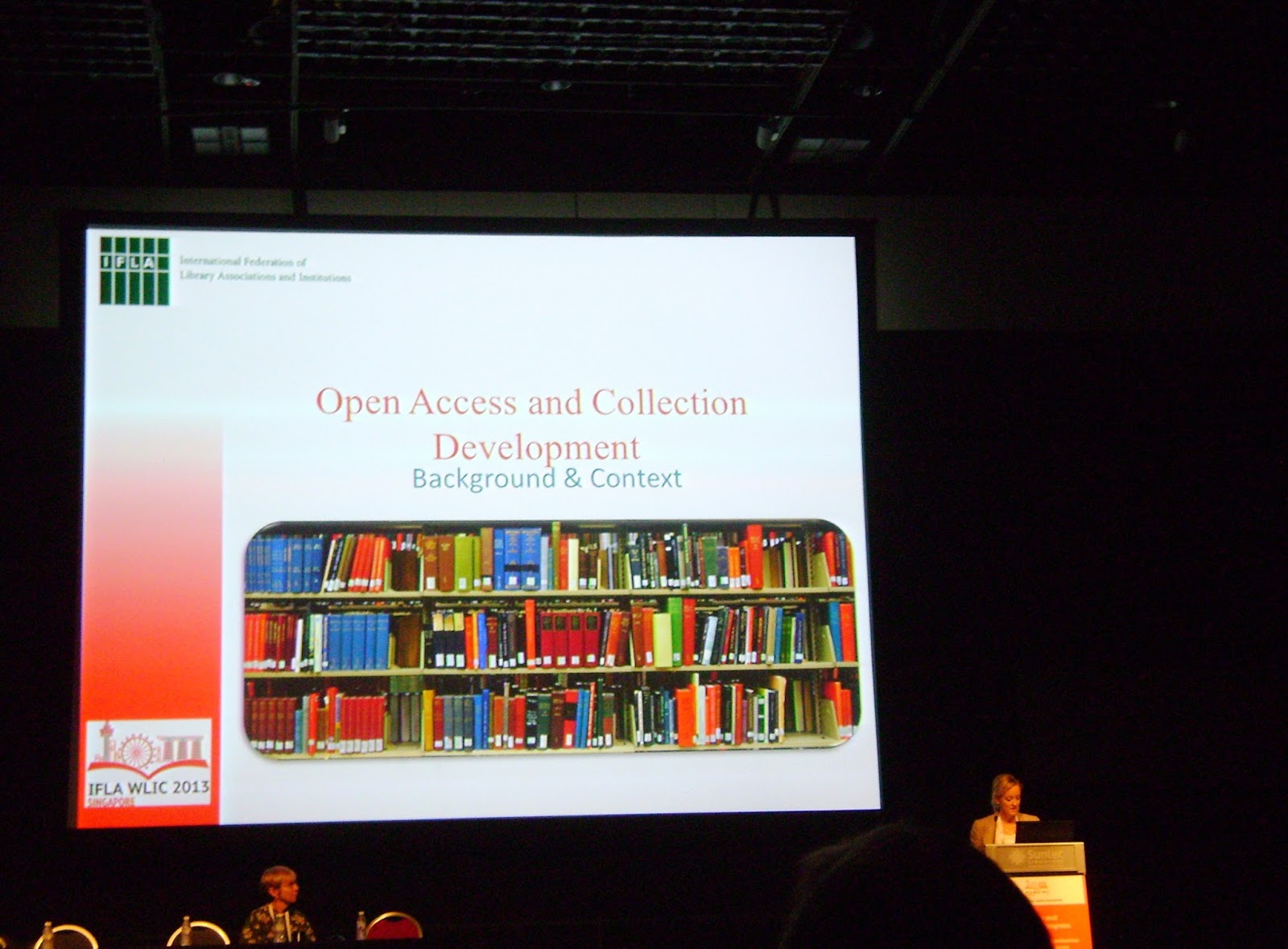 Open Access cropped up in several guises: as an aid to collection development in Canadian libraries, as an important tool in research development, and as a bridge between knowledge management and democracy. Subject access and collection management models also came under scrutiny. One newly established library explained how their collections model had been set up and the policy developed. Resource sharing models were explored, such as Taiwan's public library e-books model and the Uborrow scheme set up between several academic libraries in the mid-West of North America.
The future of MARC was a hot topic and much discussed in light of developments in linked data standards. As someone who has recently trained staff across my organisation in RDA, the future of bibliographic standards and models is very relevant to my work. If we accept that, as was proposed at this conference, a large proportion of our users are starting their information search on a web search engine, we need to make our bibliographic data more discoverable by web browsers. It is all about making sure that the library, our collections and our services, are not overlooked. We have so much value to add to the learning experience, we need to start making this more explicit.
On a professional development level, this conference was astoundingly important to me. I would encourage everyone to apply for awards and bursaries to attend international conferences. It has developed me and furthered my perspective on these issues that are affecting libraries now and will most likely continue to offer us challenges and opportunities in the future. What's really important is to recognise challenges and then turn them into positive opportunities. If we can do this, our future libraries will have infinite possibilities.


Thursday, 10 January 2013
Making an impact: the libraries@cambridge 2013 conference
The 2013 libraries@cambridge conference
certainly made an impact on me. I left the day feeling refreshed, revitalised,
rejuvenated and anything but rested! Three themes really stood out for me
throughout the day: measuring our impact, evaluating what we do and why we do
it, and the ever growing need to manage our student and academic partnerships. There
has been a lot of debate as to whether students are customers; personally I
think that whilst they’re not customers in the commercial sense, they deserve
the same if not higher standards of excellent customer care. Partners was a
term suggested throughout the day and I admit that I like this idea. We should
start to see students as partners in their own learning and adacemics as
partners with library professionals to provide strong services that underpin
the organisation’s mission. We need to bridge that link between libraries and
academics and students; perhaps by seeing us all as partners and by emphasising
the benefits of such an approach to each party from their point of view, we can
start this process.
Liz Jolly gave a really thought provoking
keynote address on the topic of measuring the impact that we as a library
service make in terms of the mission and values of our organisation. We
librarians are good at collectiong statistical data but how often is what we
collect really forming an evidence base? What does footfall really tell us
about what goes on with library resources once our users are in the building?
 |
|
©
dollpants(http://whatismowearing.blogspot.co.uk/2011/01/welcome-to-my-new-blog.html) |
We need to colect data that is relevant to
our organisational mission. We need to show how library services and resources
directly affect student performance and development.
Which led us quite nicely onto Dave Pattern and Graham Stone’s presentation on the JISC funded Library Impact Data Project.
This project sets out to directly show correlation between use of library
resources and degree classification. The slight problem that I had was that,
despite the impressive statistical data, the missing link is always that we
cannot know exactly how students use our resources. A book loaned doesn’t
always equal a book read. Perhaps the person looking at an ebook for an hour
really is reading it. Maybe they fell asleep. We’ll never know! It is a really
valuable project nevertheless because even if we have some data showing a trend
towards more library use equalling better degree, it gives us a certain level
of concrete proof of our impact to take forward to our stakeholders, i.e. our
non-librarian managers. We can prove that we make an impact and that our
resources matter. However, it would be good to have impact measurement
data of librarians as well as library resources; the information skills training
that we give does directly feed into the learning process.
Evaulation came again to the forefront of
my mind during the breakout session. We were asked to divide into teams and run
a shop. The point was quite evident from the start, that there were far too
many processes and we needed to evaluate our workflows to ensure the most
effective practices were being carried out, but the added role play element
gave particpants a freedom to make decisions and speak out. I think evaluation
is really important. However, evaluation does not have to mean change. If we
evaluate something and consider it the most useful and efficient way, then it
should indeed remain.
After a lovely lunch, I was lucky enough to
be asked to be on the panel for a talk given by Start Hunt on the future of
cataloguing. There is an ever growing mass of things to catalogue in so many
different formats and a lot of the data being pulled into library discovery
platforms is not traditional controlled data. Because of these reasons, libararians
need to accept that the data they provide on catalogues is increasingly not
under local control. The issue of workflow evaluation came up again as Stuart
discussed the extent to which we should check our records. Comments from the
panel ranged from a discussion of the Cambridge Digital Library to concerns over quality and usefulness of data to the need for faculties to
have competent cataloguers with sound judgement as records are not always
available for downloading. Certainly for foreign languages and films, I
catalogue from scratch a lot of the time (and if the records were there, I’d
use them!)
We finished off the day with an inspired
pecha kucha session. I’d never heard of this means of presenting before so I
was interested to see how it worked. It was great to have the opportunity to
hear about five diverse things that are all going on right now across our
libraries, ranging from environmental concerns and induction teaching to
timeline projects, cpd collaborations and pastoral care in Cambridge College
libraries. All in all, #lac13 was a great and inspiring day. The main thing
that stood out for me was measuring impact and showing how crucial our libraries
and librarians are by tying our work closely with the mission and values of the
University. And catching up with all the other #camlibs was, as ever, a
pleasure!
Saturday, 1 September 2012
Summer's swan song
Today it is September. Those long, balmy, (often rainy) August days are far behind us. Those days when the English sun would shine from dawn til dusk over quiet libraries, closed lecture halls, a canteen with reduced opening hours. Order and calm reigned supreme over our faculties and spires, our parks and gardens. We had such plans. We would manually upgrade all our short bibliographic records. We would catalogue our backlogs. Every shelf would be checked. Every reading list scanned. We might even be able to - wait for it - sort out the 'store room.'
And what happened? The summer we envisaged in our minds back in June went on forever. Day after day of heat and quiet and time. Buckets of time, stretching out over the weeks until the time that no one could then even imagine being real - the Start Of the New Academic Year. But the summer we saw in our minds in June was not the true being of reality; oh no, this Summer was a trickster, a prankster. She made us think she went on forever in the hot sunny days characteristic of June, July and August in England that exist only in the nostalgic memories of our childhoods. Instead of this majestic Summer, where everyone goes on long picnics and still manages to complete multiple big projects, we got summer - one rainy season followed by burning hot days where time manages to go quickly and slowly at once. And before we've had time to process where time has gone, it is September again and we're seeing on the horizon the SONAY riding out to meet us on the plains of the campus.
As the law of time goes, September will see us simultaneously riding out to meet the Start Of the New Academic Year and leaping off our metaphorical horses to run back to our projects that we planned to complete over the summer. After the quiet that has reigned supreme over the library and the campus, after two months of closed lecture halls and empty classrooms, I am waiting for the rush. Our students bring our campuses to life, their cycles lining the streets and their coats all over the library give us concrete proof that they value what we're doing and why we're here. If they didn't, they wouldn't be here, and we would have little point as libraries and librarians. And whilst every single short bibliographic record might not have been upgraded this summer, I suspect that we all completed projects and sections of bigger projects. That is what is important.
The summer always goes faster than we expect. I start missing our students in August. Every book in our library might have been shelf-checked and in the right place, but I miss our students coming in and browsing everything. I miss the clutter and the whispers and the bags and the illicit mobiles. A library should be alive and without readers it is dead. It has no point. One major thing that I have accomplished this summer is forging better links with our academics. I am now attending a big meeting for new students at the start of term to introduce the library and our services and I have been invited to resource meetings for one of our graduate degree programmes. Things are exciting, dynamic and fresh. There are challenges too, of course, but I like a challenge. When the SONAY rides out towards us, I'll be the one at the front on the big white charger.
And what happened? The summer we envisaged in our minds back in June went on forever. Day after day of heat and quiet and time. Buckets of time, stretching out over the weeks until the time that no one could then even imagine being real - the Start Of the New Academic Year. But the summer we saw in our minds in June was not the true being of reality; oh no, this Summer was a trickster, a prankster. She made us think she went on forever in the hot sunny days characteristic of June, July and August in England that exist only in the nostalgic memories of our childhoods. Instead of this majestic Summer, where everyone goes on long picnics and still manages to complete multiple big projects, we got summer - one rainy season followed by burning hot days where time manages to go quickly and slowly at once. And before we've had time to process where time has gone, it is September again and we're seeing on the horizon the SONAY riding out to meet us on the plains of the campus.
As the law of time goes, September will see us simultaneously riding out to meet the Start Of the New Academic Year and leaping off our metaphorical horses to run back to our projects that we planned to complete over the summer. After the quiet that has reigned supreme over the library and the campus, after two months of closed lecture halls and empty classrooms, I am waiting for the rush. Our students bring our campuses to life, their cycles lining the streets and their coats all over the library give us concrete proof that they value what we're doing and why we're here. If they didn't, they wouldn't be here, and we would have little point as libraries and librarians. And whilst every single short bibliographic record might not have been upgraded this summer, I suspect that we all completed projects and sections of bigger projects. That is what is important.
The summer always goes faster than we expect. I start missing our students in August. Every book in our library might have been shelf-checked and in the right place, but I miss our students coming in and browsing everything. I miss the clutter and the whispers and the bags and the illicit mobiles. A library should be alive and without readers it is dead. It has no point. One major thing that I have accomplished this summer is forging better links with our academics. I am now attending a big meeting for new students at the start of term to introduce the library and our services and I have been invited to resource meetings for one of our graduate degree programmes. Things are exciting, dynamic and fresh. There are challenges too, of course, but I like a challenge. When the SONAY rides out towards us, I'll be the one at the front on the big white charger.
Friday, 29 June 2012
ARLG Conference 2012: Get Out [Of The Library] More!
Being awarded the Alison Northover Award allowed me to
attend my first large national conference, namely the ARLG Conference 2012, in
Newcastle, June 25th – 27th. The conference, entitled ‘Great
expectations: what do students want and how do we deliver?’, explored several
extremely topical themes surrounding the rise of tuition fees and the
expectations of our students within a time of general austerity in the
information services sector.
Throughout the conference, from the keynote speaker to the
final workshop presenter, the concept of the student as customer raised its commercial
head. Opinions differed wildly; some argued that if we start calling our
students customers then they will behave like customers, expecting a good
degree as their product purchased for the cost of for example £27, 000. Others
put forward the argument that, if we’re committed to providing excellent
customer care, why not call our users customers? A compromise emerged in the
form of the terms ‘member’ or better still ‘partner’, encouraging open dialogue
between staff and students. The best
analogy I heard is that of gym membership; you can pay your fee but that doesn’t
automatically make you thin. Paying more for your degree doesn’t give you an
automatic right to a good result.
 | |||||||||||||||||||||||||
| Main exhibition room | (care of http://www.cilip.org.uk/get-involved/special-interest-groups/ucr/pages/joint-conference-2010.aspx) |
However, like it or not, I think that the rise in tuition
fees will change student expectations. Despite protestations to the contrary
from speaker Paul Abernathy, president of Liverpool John Moores' University student union, paying such vast
amounts of money will commercialise the student experience. This is not
necessarily a bad thing as long as it is managed and facilitated appropriately.
Paying almost thirty thousand pounds will not guarantee you a first, but it
will give you a more assertive voice. It will make students less willing to
accept decisions taken by library staff purely on the basis that a librarian
considers the student request to be inappropriate or not how this particular
librarian thinks a student should be conducting their learning experience. We
have to face up to the fact that we cannot ignore our students; they have to
become our partners with a voice that is respected and heard. This is a good
thing. It will make us more relevant and it will ensure that we are doing what
our students want us to do. Otherwise, what’s the point? If we sit staidly in our
ivory towers and refuse to demonstrate Google Scholar because we know a better place to go to for information, we will be bypassed. This has been going on since
the birth of the search engine made people generally more assertive in
researching their own topics, but it will increase in the future. It might be true that Literature Online has a
better data set but we as professionals need to manage these situations well.
We demonstrate Google scholar, then we mention LION. We must pick our battles.
Which leads well onto the second big theme of the
conference; ensuring that we market our products and services well through
continually stressing the benefits of the library and librarians over the
supposed ease of Google et al. Kay
Grieves and Jan Dodshon from the University of Sunderland gave a vitally useful
workshop detailing a seven stage strategic marketing plan to fully embed the
library service within the consciousness of every single student. They based
this toolkit around the concept that every student needs to feel a sense of
ownership within the library service; dialogues were stressed as a vital means
of ensuring that this happens. Feedback should be collected regularly but we
also need to encourage dialogues about library services between students,
whether via a web 2 tool or in real life on a comments board. If something is
truly impossible, we need to start explaining why. We can’t go to a
staff-student liaison committee and just say that requests are
impossible anymore. We need to explore and explain, to communicate and convey. For
example, in my library we have had requests for 24/7 opening. I would dearly
love to offer this provision but unfortunately we have no security to protect
our students after hours. Their expectation is for 24/7 opening; we mitigate
this through dialogue. This is how we need to start dealing with rising student
expectations.
After all, how do your students know that your service isn’t
necessarily richer due to their higher fees? I can see it now: “I pay your
wages, why can’t you stay here until later in the evenings?” Some say it with MPs; “I pay their wages and they’re fiddling their expenses?” If we explain, we
can deal with this situation well. We could even turn our students into
ambassadors for our service, canvassing for higher budgets and rallying against
staff cuts. We could do this. But only if we explain things well via open
dialogues.
The final theme that came out of the conference was all about how we can measure the impact of the library service on the overall student learning experience. How does what we do improve what they do? We need to collect evidence. Every time we run a training event, we need to gather feedback and ask the right types of questions to be able to match responses on to the learning and skills outcomes of our faculties and institutions. This gives us harder evidence than purely anecdotal quotes, although it is still only a perception and only goes some way to justifying the need for the services that we provide. Essentially it comes back to gathering feedback, although this time it is for a slightly different purpose.
The three days were a genuine whirl of new ideas, new
projects, new people, a great quiz, a lovely gala dinner at the Baltic, some
wonderfully inspiring workshops and some very inspiring people. A particular
mention should be made of the Serious Play workshop hosted by Andy Priestner and facilitated by Libby Tilley; if you ever have the
chance to do it, grab it quick! It’s a really interesting experience that can
tell you a lot about your thoughts about people and services that you didn’t already know. And finally, a
big thank you to the ARLG committee for organising such a great conference and
for awarding me the Alison Northover Award. Since returning to my institution,
I have already had approval for a new information skills marketing campaign to
launch in a few months and I will be attending a big departmental meeting for
new freshers in October in a bid to become much more outward facing. My motto for
the academic year 2012-13: get out [of the library] more!
Monday, 16 April 2012
Not so cool but definitely a librarian
After reading the excellent blog post over on Library Wanderer's blog, I started thinking about the image of librarians and the ways in which we're going about our advocacy campaigns. Stereotypes of librarians still pervade our society's popular consciousness. Only recently, there was *that* Helena Bonham Carter video, the term 'librarian' is bandied about in the news as a metaphor for out of date outmoded thinking, and only recently a friend of a friend that I met for the first time said 'yep, you look a bit librariany.' These images are all around us, but what exactly do they mean, and what do they say about society's relationship to libraries and librarians?
Most people know that librarians often don't look like Marion the Librarian or Helena Bonham Carter. Yet, there is this cultural stereotype to which people automatically refer. That is the point of the This is what a librarian looks like tumblr. I don't think it's trying to prove the 'hey, we're librarians, but we're cool and wacky, right?' line of argument. I think it's trying to show that librarians quite often look very different from the stereotypical image. Where it falls down is when librarians are in fancy dress, or doing some wacky hobby, or when of course they look a bit like a stereotypical librarian. Stereotypes are around for a reason and whilst the librarian stereotype has inflated to a point beyond reality, the roots of the stereotype must have originally come from somewhere. This could well reflect the changing nature of the profession; in the past it was dominated by bookish types who wanted a quiet life guarding collections and now it is filled with boombastic bubbly blondes who want to promote resources and engage with users. I suspect that this clean-cut division isn't true either. People who like to read are drawn to librarianship but then again, there are readers in every profession. And librarianship isn't about reading books; it's about uniting our users with their information and showing them how to use it for maximum output. The public link librarians with books because it is the easiest way to contextualise what we do, but think of all the librarians in libraries who never see a physical book at all.
It comes down essentially to advocacy. Instead of focusing on these stereotypes, I think we should be focusing on what we do and how we do it well. Every profession engages in advocacy, but some need it more than others. We need to be more transparent and explain to people what we actually do. Challenge the person at a party who looks at you with envy, saying 'it must be lovely to read all day.' 'Well, yes it would,' I replied to this friend of a friend who thought I looked librariany. 'Unfortunately, what with making online records for all our new acquisitions, updating our social media presence, responding to emails, helping a user with a complex ejournals access problem and planning a new information skills session, I can't say I'd have the time.'
 | |||
| What a librarian looks like |
Most people know that librarians often don't look like Marion the Librarian or Helena Bonham Carter. Yet, there is this cultural stereotype to which people automatically refer. That is the point of the This is what a librarian looks like tumblr. I don't think it's trying to prove the 'hey, we're librarians, but we're cool and wacky, right?' line of argument. I think it's trying to show that librarians quite often look very different from the stereotypical image. Where it falls down is when librarians are in fancy dress, or doing some wacky hobby, or when of course they look a bit like a stereotypical librarian. Stereotypes are around for a reason and whilst the librarian stereotype has inflated to a point beyond reality, the roots of the stereotype must have originally come from somewhere. This could well reflect the changing nature of the profession; in the past it was dominated by bookish types who wanted a quiet life guarding collections and now it is filled with boombastic bubbly blondes who want to promote resources and engage with users. I suspect that this clean-cut division isn't true either. People who like to read are drawn to librarianship but then again, there are readers in every profession. And librarianship isn't about reading books; it's about uniting our users with their information and showing them how to use it for maximum output. The public link librarians with books because it is the easiest way to contextualise what we do, but think of all the librarians in libraries who never see a physical book at all.
It comes down essentially to advocacy. Instead of focusing on these stereotypes, I think we should be focusing on what we do and how we do it well. Every profession engages in advocacy, but some need it more than others. We need to be more transparent and explain to people what we actually do. Challenge the person at a party who looks at you with envy, saying 'it must be lovely to read all day.' 'Well, yes it would,' I replied to this friend of a friend who thought I looked librariany. 'Unfortunately, what with making online records for all our new acquisitions, updating our social media presence, responding to emails, helping a user with a complex ejournals access problem and planning a new information skills session, I can't say I'd have the time.'
Monday, 2 April 2012
Quality of Qualtrics
I recently went to a training course in Qualtrics, a survey design software package that allows so much freedom in the customisation and personalisation of your surveys.
I was really impressed with what I learned. Qualtrics has hundreds of question types, you can embed different media into your survey, and you can do some very clever tabulation of responses to different questions to spot patterns and trends as they emerge. And the best part is that the computer programme does most of the statistics work, leaving you free to analyse and act on the results.

Every member of my institution has access to Qualtrics during a trial period; I'm definitely going to explore it fully. With more functionality, and the ability to customise more fully, than SurveyMonkey, this is definitely something worth investigating.
I was really impressed with what I learned. Qualtrics has hundreds of question types, you can embed different media into your survey, and you can do some very clever tabulation of responses to different questions to spot patterns and trends as they emerge. And the best part is that the computer programme does most of the statistics work, leaving you free to analyse and act on the results.

Every member of my institution has access to Qualtrics during a trial period; I'm definitely going to explore it fully. With more functionality, and the ability to customise more fully, than SurveyMonkey, this is definitely something worth investigating.
Monday, 19 March 2012
The Gift of a Prezi
Last week, I had the most exhillerating experience of my career so far: my colleague and I ran a training session for online resources to all the second year undergraduates who are preparing to go on their year abroad.
The year abroad is a compulsory requirement for our undergraduates; they spend their third year in another country either studying or working. They do a wide range of things, from working in a Peruvian school to working at the Hague or studying in Heidelberg. The one thing that they must all do by the end of their year abroad is complete a year abroad project. For this project, they need resources - books, articles, dictionaries - essentially, information. This can panic our students - they can't borrow library books for a year, what will they do for resources? Which is where this session came in very useful.
I have been running one-to-one information literacy and skills sessions for several years and in previous roles I have given training to subject groups on electronic resources and evaluation. Never before has it been on the scale of 140 students; it was an amazing experience. Working closely with my colleague for several weeks before the session was a really useful experience; although we did not always agree, we worked together to reach compromises and solutions which fit us both. We worked out how we would hang the information literacy strands off the framework of discovering resources: we plumped for off-campus access explanation, finding information, analysing information, storing your resources and references. These strands hung from the practical skills framework of finding and using ebooks, ejournals, LION and Web of Knowledge, bibliographies, other resources such as encyclopedias and dictionaries, concluding with different reference management options. We used our website as an aggregator; this page is the one-stop place to come to to find everything else. It went down well. I had some great feedback from students and the staff found it helpful too.
Thus our dynamic Prezi presentation served two vitally important purposes: it reassured our students that, although they will not be on campus next year, they are still supported by the University's ample resources and it also raised the profile of the library amongst our academic colleagues. This advocacy is vital to ensure our continued value as a library service at all levels of our institution. I thoroughly enjoyed preparing and running the session - I can't wait to develop in this area in the future.
The year abroad is a compulsory requirement for our undergraduates; they spend their third year in another country either studying or working. They do a wide range of things, from working in a Peruvian school to working at the Hague or studying in Heidelberg. The one thing that they must all do by the end of their year abroad is complete a year abroad project. For this project, they need resources - books, articles, dictionaries - essentially, information. This can panic our students - they can't borrow library books for a year, what will they do for resources? Which is where this session came in very useful.
I have been running one-to-one information literacy and skills sessions for several years and in previous roles I have given training to subject groups on electronic resources and evaluation. Never before has it been on the scale of 140 students; it was an amazing experience. Working closely with my colleague for several weeks before the session was a really useful experience; although we did not always agree, we worked together to reach compromises and solutions which fit us both. We worked out how we would hang the information literacy strands off the framework of discovering resources: we plumped for off-campus access explanation, finding information, analysing information, storing your resources and references. These strands hung from the practical skills framework of finding and using ebooks, ejournals, LION and Web of Knowledge, bibliographies, other resources such as encyclopedias and dictionaries, concluding with different reference management options. We used our website as an aggregator; this page is the one-stop place to come to to find everything else. It went down well. I had some great feedback from students and the staff found it helpful too.
Thus our dynamic Prezi presentation served two vitally important purposes: it reassured our students that, although they will not be on campus next year, they are still supported by the University's ample resources and it also raised the profile of the library amongst our academic colleagues. This advocacy is vital to ensure our continued value as a library service at all levels of our institution. I thoroughly enjoyed preparing and running the session - I can't wait to develop in this area in the future.
Thursday, 8 March 2012
Library Tours
As the year turns again towards Spring and I once again offer my apologies for the blogging pause, I've been thinking about library tours. There's been a lot of talk lately about library tours. Who do we give them to? How do we do them? And what do people think about them?

This is the library in which I work. A few weeks ago, I gave a library tour to a group of library and information professionals from across the East of England. I organised a day of tours and visits which included a college library with special collections, a busy faculty library, and a different type of academic library service. The aim was to give people outside the Cambridge academic sector the opportunity to see how things work and how different the different types of libraries really are. They serve different resource needs. The aim was fulfilled as participants came from Norfolk and Bedford and several different sectors were represented.
Organising the day was quite a lot of work. I prepared packs including maps on how to find the different libraries, I thought very hard about what I wanted to show and tell, and I collated feedback from participants to evaluate the event. Yet the whole experience of event management was a real development opportunity for me and my tour participants gained a lot from seeing other libraries and other ways of running services.
I think this is the key: library tours given by information pros to information pros need to be different to other types of library tour. We all work with information - we know how Boolean works! We might have a deeper interest in a library's in-house classification scheme than the average student. We might care about which Library Management System is used or how the use of ebooks is affecting print loans. We need to tailor our tours. And whilst it's true that it can become a lot of work for the tour-giver, giving a tour to fellow professionals taught me a lot about confidence and dealing with difficult questions!
So today we have another tour organised for our colleagues within the libraries of Cambridge's Colleges. I'm also giving a tour to some tweeple later on in March. By giving tours, we can reflect and muse on our policies and procedures as we explain them to others. It helps to keep us fresh and our services as relevant to our users as they can be. And giving reciprocal tours to colleagues across the profession is a great way to engage in CPD during economically challenging times!

This is the library in which I work. A few weeks ago, I gave a library tour to a group of library and information professionals from across the East of England. I organised a day of tours and visits which included a college library with special collections, a busy faculty library, and a different type of academic library service. The aim was to give people outside the Cambridge academic sector the opportunity to see how things work and how different the different types of libraries really are. They serve different resource needs. The aim was fulfilled as participants came from Norfolk and Bedford and several different sectors were represented.
Organising the day was quite a lot of work. I prepared packs including maps on how to find the different libraries, I thought very hard about what I wanted to show and tell, and I collated feedback from participants to evaluate the event. Yet the whole experience of event management was a real development opportunity for me and my tour participants gained a lot from seeing other libraries and other ways of running services.
I think this is the key: library tours given by information pros to information pros need to be different to other types of library tour. We all work with information - we know how Boolean works! We might have a deeper interest in a library's in-house classification scheme than the average student. We might care about which Library Management System is used or how the use of ebooks is affecting print loans. We need to tailor our tours. And whilst it's true that it can become a lot of work for the tour-giver, giving a tour to fellow professionals taught me a lot about confidence and dealing with difficult questions!
So today we have another tour organised for our colleagues within the libraries of Cambridge's Colleges. I'm also giving a tour to some tweeple later on in March. By giving tours, we can reflect and muse on our policies and procedures as we explain them to others. It helps to keep us fresh and our services as relevant to our users as they can be. And giving reciprocal tours to colleagues across the profession is a great way to engage in CPD during economically challenging times!
Monday, 31 October 2011
An Apology and a Resurgence
Firstly, an apology. I am afraid that my blog has, in recent months, suffered the same fate of all of my adolescent diaries and been left to gather cobwebs in some long forgotten corner of the spare room. However, today marks the beginning of my virtual resurgence of the blog. I offer no promises though on the regularity of content.
This time of year, when the balance of light and darkness moves and everything appears tinged with an eldritch air, is a time of reflection. After a summer fraught with building works, followed by a busy start to the academic year, we are now half way through the term. As the cycle of the academic year moves towards the end of the first term, we can reflect about what we have done well and what we can do better next time. I was particularly struck by Miss Julie’s blog post about librarians weeding themselves. If we had to apply the same rules to our profession as we do to our stock, how would we look? I think it is true that we have to constantly reflect on our skills and behaviours and evaluate how we do things.
I am currently going through the process of Chartership and, as such, have been encouraged to analyse myself and my workflows. Why do I do this? Is this the best way of doing this? How can I be more efficient? How can I better serve my institution? How can we make sure that our information service (and that’s what it is, a service with readers as customers) supports the mission of our institution as best as it possibly can? These are all crucial questions to ask. The answers can range from evaluation of workflows to experimenting with changes in some areas. I don’t believe in change for the sake of change, but I do think that we need to be constantly reflecting and evaluating our service and our procedures.
If I ever start to show the signs of a MUSTIE, someone please tell me! Happy Halloween everybody.
This time of year, when the balance of light and darkness moves and everything appears tinged with an eldritch air, is a time of reflection. After a summer fraught with building works, followed by a busy start to the academic year, we are now half way through the term. As the cycle of the academic year moves towards the end of the first term, we can reflect about what we have done well and what we can do better next time. I was particularly struck by Miss Julie’s blog post about librarians weeding themselves. If we had to apply the same rules to our profession as we do to our stock, how would we look? I think it is true that we have to constantly reflect on our skills and behaviours and evaluate how we do things.
I am currently going through the process of Chartership and, as such, have been encouraged to analyse myself and my workflows. Why do I do this? Is this the best way of doing this? How can I be more efficient? How can I better serve my institution? How can we make sure that our information service (and that’s what it is, a service with readers as customers) supports the mission of our institution as best as it possibly can? These are all crucial questions to ask. The answers can range from evaluation of workflows to experimenting with changes in some areas. I don’t believe in change for the sake of change, but I do think that we need to be constantly reflecting and evaluating our service and our procedures.
If I ever start to show the signs of a MUSTIE, someone please tell me! Happy Halloween everybody.
Tuesday, 2 August 2011
Librarianship, Qualifications, Careers
For Things 10 and 11 this week, I am blogging about my route into librarianship and my experiences thus far in the profession. Like most arts graduates, I was unsure of my career path after University. In my naïve and youthful state, I had imagined that it would be perfectly feasible to walk from my graduation ceremony into a publishing house who agreed to publish my first novel right there and then. Or perhaps I’d walk into the editorial office of the Guardian and be swept away on a magic carpet of opening nights, films festivals and cocktail parties.
Reality hit hard soon after I had relocated to Cambridgeshire as I began the inevitable rounds of administrative temping. I found myself in an administrative role in an academic environment, a good job which would have been stable enough to secure my future. And yet. Every time the word ‘library’ was mentioned, I would wonder. Ponder. I remembered my childhood days of “playing” at being a librarian. I confess, I even set up the “Friendly Lending Library” with my own books and made library cards for my readers. Not a family gathering went by without my relentless recruitment of new patrons from amongst the guests. In junior school, I became a pupil librarian. This was back in the day, with catalogue cards and manual issue.
It is odd therefore that as an adult these memories took a while to surface into the basis of a real career. It was when I really started considering what to do with my life that librarianship called to me. I am passionate about connecting the reader to their desired information and helping them to learn the skills to find and use quality resources. I left a permanent well paid administrative post to move into a junior library assistant role and I am extremely glad that I did. I have a grounding of library work at all levels, something that helps me to empathise with junior staff in a way that I suspect would be difficult if I’d not had entry level experience. I have been lucky in my career so far in that I have worked in a diverse variety of libraries in all three parts of the Cambridge tripartite system, before finding my feet in my first professional post.
I decided to begin the Aberystwyth course via distance learning after working for one year as a junior library assistant. I was sure that this was the career for me and I wanted to become more engaged with the LIS sector. I had the opportunity at that point to move into a SCONUL graduate traineeship which helped me to develop myself and to view myself as a professional practitioner. The Aberystwyth course appealed to me for several reasons: it is progressive, it ties together theory and practice, and it is affordable. I was able to apply my learnt knowledge to the workplace in order to see the limitations of theory and the practicalities of librarianship. As a keen Open University student, the distance learning world was not unfamiliar to me and I enjoy setting my own deadlines.
I completed the MSc in Library and Information Science in September 2010.
I am currently working towards my Chartership. The process is already teaching me a lot about reflexion and service evaluation. I have been in my current post as Assistant Librarian managing three collections for just over three years. Let's see what the future will bring.
Reality hit hard soon after I had relocated to Cambridgeshire as I began the inevitable rounds of administrative temping. I found myself in an administrative role in an academic environment, a good job which would have been stable enough to secure my future. And yet. Every time the word ‘library’ was mentioned, I would wonder. Ponder. I remembered my childhood days of “playing” at being a librarian. I confess, I even set up the “Friendly Lending Library” with my own books and made library cards for my readers. Not a family gathering went by without my relentless recruitment of new patrons from amongst the guests. In junior school, I became a pupil librarian. This was back in the day, with catalogue cards and manual issue.
It is odd therefore that as an adult these memories took a while to surface into the basis of a real career. It was when I really started considering what to do with my life that librarianship called to me. I am passionate about connecting the reader to their desired information and helping them to learn the skills to find and use quality resources. I left a permanent well paid administrative post to move into a junior library assistant role and I am extremely glad that I did. I have a grounding of library work at all levels, something that helps me to empathise with junior staff in a way that I suspect would be difficult if I’d not had entry level experience. I have been lucky in my career so far in that I have worked in a diverse variety of libraries in all three parts of the Cambridge tripartite system, before finding my feet in my first professional post.
I decided to begin the Aberystwyth course via distance learning after working for one year as a junior library assistant. I was sure that this was the career for me and I wanted to become more engaged with the LIS sector. I had the opportunity at that point to move into a SCONUL graduate traineeship which helped me to develop myself and to view myself as a professional practitioner. The Aberystwyth course appealed to me for several reasons: it is progressive, it ties together theory and practice, and it is affordable. I was able to apply my learnt knowledge to the workplace in order to see the limitations of theory and the practicalities of librarianship. As a keen Open University student, the distance learning world was not unfamiliar to me and I enjoy setting my own deadlines.
I completed the MSc in Library and Information Science in September 2010.
I am currently working towards my Chartership. The process is already teaching me a lot about reflexion and service evaluation. I have been in my current post as Assistant Librarian managing three collections for just over three years. Let's see what the future will bring.
Friday, 22 July 2011
DREaM Conference Report
The “Developing Research Excellence and Methods” project launch event “Out of the Comfort Zone”, held at the British Library on Tuesday 19th July 2011, highlighted some important issues surrounding Library and Information Science research. As a recipient of a sponsored place at the launch event, I was extremely interested to hear more about the challenges and complexities of LIS research and practice. I would like to give my thanks to TFPL Intelligent Resources , Sue Hill Recruitment and Glen Recruitment for enabling me to attend this conference through their support of sponsored places for new professionals.
Professor Hazel Hall opened the conference by outlining the main aims and goals of the DREaM project. The project, funded by the Arts and Humanities Research Council and the LIS Research Coalition, aims to develop a formal network of LIS researchers and practitioners in order to build the capability and capacity of LIS research. The goal is to raise the quality and perceived importance of LIS research across disciplines in order to build a foundation for long-term inter-disciplinary research collaborations. The project consists of this launch conference, three workshops throughout the year where cross-discipline research methodologies will be analysed in detail, and a concluding conference in July 2012. Hall spoke of a ‘cadre’ of committed individuals that the project aims to bring together. After the concluding event next year, it is vital that there remains a core group of professionals who are committed to the aims of the project.
Professor Blaise Cronin then gave an insightful and interesting keynote speech on the historical and current problems surrounding LIS research. Collaboration appears to be the key to strengthening confidence. Cronin took us on a history of LIS research and asked whether there really was a Golden Age for our discipline. The problem is that LIS research has for too long been seen by researchers in other disciplines as a hobby, rather than a rigorous and scientific discipline. Take for example the area of information behaviour. This is a logical area in which LIS research should collaborate with educational and cognitive psychological research. Yet the body of LIS research is often overlooked. Cronin asks us to ask why. He suggests various reasons, including the lack of metadata analysis and the weak experimental design of much LIS research. Citation analysis shows whether or not articles are being cited outside the LIS sphere but I would be cautious about drawing too many conclusions from such a figure. After all, information behaviour is an area which is of great interest to practitioners in many fields. A lack of citation figures does not mean than these articles are not being read. Cronin asks us to look at methodologies from other disciplines, for example evidence-based practice, to evaluate their usefulness within LIS research. By using different methodologies, it is possible that the research output will be perceived as more reliable by other disciplines. The ‘One Minute Madness’ session that followed was really interesting as delegates heard about a number of various projects currently taking place in the LIS field.
After an exquisite lunch, we moved into our selected breakout groups . With my focus on developing and maintaining networks, I was fortunate to attend the session ran by Professor Gunilla Widén on the topic of network development in the Nordic countries. Despite their differences, the Nordic countries historically feel a wealth of commonality between them. There are established trends of formal co-operation throughout the Nordic countries, built on common values and willingness by all to develop Nordic competencies and competitiveness. This established collaboration smoothed the path to establishing networks in the LIS sphere. However, there are also problems. A delicate balance has to be maintained between national, Nordic and international interests. Different emphases and different personalities also bring challenges. Yet together they promote the Nordic countries as a whole much more strongly than they could do individually.
For me, the discussion that followed the breakout session was one of the most important parts of the day. One member of our group asked why there was such a gap between research and practice, a question that sparked intense and passionate debate. Some felt that there was little practical relevance in research. Others stated that research was not lofty and irrelevant to practice but instead was crucial to helping practitioners to solve problems. Yet it is true that research output often does not affect organisational practice, a point which was used by some to state that practitioners were thus not engaging with research. I put myself well and truly out of my comfort zone by jumping in and stating that this was often not the case. As a practitioner, but also as a new professional, I certainly engage with LIS research. However, organisational culture and the constraints of practice limit the extent to which research can be implemented. It is important not to assume that, because things are not rapidly changing on the ground, research is not being evaluated by any practitioners. The discussion veered then onto networks. What drives a network after the funding runs dry? I am a part of several networks, including CILIP’s Career Development Group and my area specific German Studies Library Group. I participate in these groups, I give my time to attend events, I am on the committee of CDG in the East of England. I do it because it is valuable professionally. It develops me as a person and as a professional. I am doing something useful and creating a network of practitioners. There is no financial incentive and yet I and my fellow members are committed and enthusiastic enough to establish and build a network.
Dr Dylan Evans gave the closing keynote speech, which was interesting and fascinating. His career spans a number of roles and disciplines, which makes him the perfect candidate to speak about inter-disciplinary collaboration. Collaboration encourages creative thinking as preconceived knowledge and assertions are washed away. In order to become cross collaborative, we must engage with other disciplines and move forward into other spheres.
The two main themes that emerged from the day concerned the need to assess the current situation with LIS research and research methodologies whilst exploring how we can establish a formal network of LIS researchers and practitioners. Discussing the gap between research and practice was a crucial part of the day. Collaboration between researchers and practitioners is the first step to closing this gap within our own profession before we move forwards into cross-discipline collaboration. This is achievable by networking to understand the perspectives and challenges that researchers and practitioners face. I sincerely hope that through the course of this year, the first steps towards this mutual understanding can be taken in order to move forward in establishing a formal LIS network. Research should inform practice but practical problems should also determine the focus of the LIS research landscape to an extent. Understanding each other is the first step towards the formation of a solid permanent network.
Professor Hazel Hall opened the conference by outlining the main aims and goals of the DREaM project. The project, funded by the Arts and Humanities Research Council and the LIS Research Coalition, aims to develop a formal network of LIS researchers and practitioners in order to build the capability and capacity of LIS research. The goal is to raise the quality and perceived importance of LIS research across disciplines in order to build a foundation for long-term inter-disciplinary research collaborations. The project consists of this launch conference, three workshops throughout the year where cross-discipline research methodologies will be analysed in detail, and a concluding conference in July 2012. Hall spoke of a ‘cadre’ of committed individuals that the project aims to bring together. After the concluding event next year, it is vital that there remains a core group of professionals who are committed to the aims of the project.
Professor Blaise Cronin then gave an insightful and interesting keynote speech on the historical and current problems surrounding LIS research. Collaboration appears to be the key to strengthening confidence. Cronin took us on a history of LIS research and asked whether there really was a Golden Age for our discipline. The problem is that LIS research has for too long been seen by researchers in other disciplines as a hobby, rather than a rigorous and scientific discipline. Take for example the area of information behaviour. This is a logical area in which LIS research should collaborate with educational and cognitive psychological research. Yet the body of LIS research is often overlooked. Cronin asks us to ask why. He suggests various reasons, including the lack of metadata analysis and the weak experimental design of much LIS research. Citation analysis shows whether or not articles are being cited outside the LIS sphere but I would be cautious about drawing too many conclusions from such a figure. After all, information behaviour is an area which is of great interest to practitioners in many fields. A lack of citation figures does not mean than these articles are not being read. Cronin asks us to look at methodologies from other disciplines, for example evidence-based practice, to evaluate their usefulness within LIS research. By using different methodologies, it is possible that the research output will be perceived as more reliable by other disciplines. The ‘One Minute Madness’ session that followed was really interesting as delegates heard about a number of various projects currently taking place in the LIS field.
After an exquisite lunch, we moved into our selected breakout groups . With my focus on developing and maintaining networks, I was fortunate to attend the session ran by Professor Gunilla Widén on the topic of network development in the Nordic countries. Despite their differences, the Nordic countries historically feel a wealth of commonality between them. There are established trends of formal co-operation throughout the Nordic countries, built on common values and willingness by all to develop Nordic competencies and competitiveness. This established collaboration smoothed the path to establishing networks in the LIS sphere. However, there are also problems. A delicate balance has to be maintained between national, Nordic and international interests. Different emphases and different personalities also bring challenges. Yet together they promote the Nordic countries as a whole much more strongly than they could do individually.
For me, the discussion that followed the breakout session was one of the most important parts of the day. One member of our group asked why there was such a gap between research and practice, a question that sparked intense and passionate debate. Some felt that there was little practical relevance in research. Others stated that research was not lofty and irrelevant to practice but instead was crucial to helping practitioners to solve problems. Yet it is true that research output often does not affect organisational practice, a point which was used by some to state that practitioners were thus not engaging with research. I put myself well and truly out of my comfort zone by jumping in and stating that this was often not the case. As a practitioner, but also as a new professional, I certainly engage with LIS research. However, organisational culture and the constraints of practice limit the extent to which research can be implemented. It is important not to assume that, because things are not rapidly changing on the ground, research is not being evaluated by any practitioners. The discussion veered then onto networks. What drives a network after the funding runs dry? I am a part of several networks, including CILIP’s Career Development Group and my area specific German Studies Library Group. I participate in these groups, I give my time to attend events, I am on the committee of CDG in the East of England. I do it because it is valuable professionally. It develops me as a person and as a professional. I am doing something useful and creating a network of practitioners. There is no financial incentive and yet I and my fellow members are committed and enthusiastic enough to establish and build a network.
Dr Dylan Evans gave the closing keynote speech, which was interesting and fascinating. His career spans a number of roles and disciplines, which makes him the perfect candidate to speak about inter-disciplinary collaboration. Collaboration encourages creative thinking as preconceived knowledge and assertions are washed away. In order to become cross collaborative, we must engage with other disciplines and move forward into other spheres.
The two main themes that emerged from the day concerned the need to assess the current situation with LIS research and research methodologies whilst exploring how we can establish a formal network of LIS researchers and practitioners. Discussing the gap between research and practice was a crucial part of the day. Collaboration between researchers and practitioners is the first step to closing this gap within our own profession before we move forwards into cross-discipline collaboration. This is achievable by networking to understand the perspectives and challenges that researchers and practitioners face. I sincerely hope that through the course of this year, the first steps towards this mutual understanding can be taken in order to move forward in establishing a formal LIS network. Research should inform practice but practical problems should also determine the focus of the LIS research landscape to an extent. Understanding each other is the first step towards the formation of a solid permanent network.
Thursday, 21 July 2011
IRL In 'Better Than Twitter' Shocker
As someone who over the last few years has come to rely heavily on Twitter.com as a networking tool, I was happily surprised to discover last night that IRL can actually be even more fun sometimes!
IRL - or In Real Life - networking is scary, much more difficult that online networking, because we actually have to put ourselves out there. So it was with no small amount of trepidation that I went to the cpd23 Thing 7 tweet-up last night. Walking towards the pub, I'll admit I was nervous.
It is only once you've arrived and started talking to people that you remember how much fun real-life networking can be. Catching up with people, sharing current news, makes all the online networking that we do more real somehow. Face to face networking reminds us about how every other part of our networking life fits together.
I was also at the event last night as a representative of a spcial interest group, namely CDG. I was pleased that I managed to chat to a few people, including new professionals, about the group and the benefits of joining CILIP. The main criticism was that if people can go to events as non-members at only slightly more cost then members, what incentive is there to join? And I'm not sure about that really. Limiting events to members would remove a revenue source and make the group more elitist, but perhaps it would encourage membership. It is a risky strategy. I took the line that if you are a passive CILIP member then it is true that you do not get the most out of your subscription. You need to be actively engaged in order to fully be a part of a professional body. Everything that you experience as a committee member, the positive and the negative times, develop you both personally and professionally. And I think I even convinced one person to consider joining a committee, so my work there was certainly done!
Many thanks to the East of England CILIP branch for organising such a worthwhile event.
IRL - or In Real Life - networking is scary, much more difficult that online networking, because we actually have to put ourselves out there. So it was with no small amount of trepidation that I went to the cpd23 Thing 7 tweet-up last night. Walking towards the pub, I'll admit I was nervous.
It is only once you've arrived and started talking to people that you remember how much fun real-life networking can be. Catching up with people, sharing current news, makes all the online networking that we do more real somehow. Face to face networking reminds us about how every other part of our networking life fits together.
I was also at the event last night as a representative of a spcial interest group, namely CDG. I was pleased that I managed to chat to a few people, including new professionals, about the group and the benefits of joining CILIP. The main criticism was that if people can go to events as non-members at only slightly more cost then members, what incentive is there to join? And I'm not sure about that really. Limiting events to members would remove a revenue source and make the group more elitist, but perhaps it would encourage membership. It is a risky strategy. I took the line that if you are a passive CILIP member then it is true that you do not get the most out of your subscription. You need to be actively engaged in order to fully be a part of a professional body. Everything that you experience as a committee member, the positive and the negative times, develop you both personally and professionally. And I think I even convinced one person to consider joining a committee, so my work there was certainly done!
Many thanks to the East of England CILIP branch for organising such a worthwhile event.
Tuesday, 19 July 2011
Online Networks, Networking and Netting an Opportunity
Thinking about online networks for Thing 6 got me thinking about the online networks in which I participate and why I take an active part in these communities. I tweet, I blog, I read and comment on other blogs. I am also an active member of Librarians as Teachers (LAT) and the LIS New Professionals Network (LISNPN) I am on LinkedIn and maintain a current profile. I do this because I enjoy being professionally linked in to the sector, to other professionals, to keep up to date with activity across sectors and to maintain an online profile.
Today I attended the LIS DREaM conference launch at the British Library. In our breakout session, a lively discussion took place on the topic of networking and sustaining collaboration. One of the questions raised concerned motivation: who is motivated to not only contribute to these online networks but also to lead the action in these networks? Any network needs motivated leaders who are able to rouse and inspire other members. Networks tend to come together due to a shared interest or area of expertise. For example, LAT concerns people across sectors involved in information skills teaching whereas LISNPN concerns people from all sectors but only if they happen to be a new professional. Are we able to communicate across sectors and stages of our careers? If we can do this, could we start to move to the next phase of cross-discipline networking?
There are formal and informal networks, online and in the real world. This got me thinking about the other networks that I am involved with, ones that don't happen in the online sphere but rather in the physical space.
I am a member of the Career Development Group committee. CDG is a network of professionals at all stages of their career from all sectors. I am a member of the German Studies Library Group, a group of library and information professionals working in some way with Germanic collections. I am an editor of CULIB, a newsletter for staff at the University of Cambridge . My conclusion is that networks are everywhere. We should not forget that, in this online digital age, not every network to which we belong will have an online space.
Which leads me on nicely to tomorrow night's CPD23 meet-up. We can network with each other in reality as well as online. True, online networking overcomes barriers of travel and cost. However, reality networking is crucial to development and must not be forgotten as an important tool.
Finally, today one delegate asked the conference how a network is expected to survive once there is no longer funding. Answers ranged from strong leadership to formalised sturctures. However, it is my honest opinion that networks do survive without funding, both formally and informally, online and offline. All we need is a group of committed individuals with vision and focus who support and inspire each other.
Today I attended the LIS DREaM conference launch at the British Library. In our breakout session, a lively discussion took place on the topic of networking and sustaining collaboration. One of the questions raised concerned motivation: who is motivated to not only contribute to these online networks but also to lead the action in these networks? Any network needs motivated leaders who are able to rouse and inspire other members. Networks tend to come together due to a shared interest or area of expertise. For example, LAT concerns people across sectors involved in information skills teaching whereas LISNPN concerns people from all sectors but only if they happen to be a new professional. Are we able to communicate across sectors and stages of our careers? If we can do this, could we start to move to the next phase of cross-discipline networking?
There are formal and informal networks, online and in the real world. This got me thinking about the other networks that I am involved with, ones that don't happen in the online sphere but rather in the physical space.
I am a member of the Career Development Group committee. CDG is a network of professionals at all stages of their career from all sectors. I am a member of the German Studies Library Group, a group of library and information professionals working in some way with Germanic collections. I am an editor of CULIB, a newsletter for staff at the University of Cambridge . My conclusion is that networks are everywhere. We should not forget that, in this online digital age, not every network to which we belong will have an online space.
Which leads me on nicely to tomorrow night's CPD23 meet-up. We can network with each other in reality as well as online. True, online networking overcomes barriers of travel and cost. However, reality networking is crucial to development and must not be forgotten as an important tool.
Finally, today one delegate asked the conference how a network is expected to survive once there is no longer funding. Answers ranged from strong leadership to formalised sturctures. However, it is my honest opinion that networks do survive without funding, both formally and informally, online and offline. All we need is a group of committed individuals with vision and focus who support and inspire each other.
Monday, 18 July 2011
RSS and All That Jazz
This week in the cpd23 programme, we are covering Thing 4: current awareness.
I really don't have much to say about this one. I actively use Twitter.com in order to keep up to date professionally and I also follow some celebrity-type people. The debate as to whether a Twitter presence should be purely professional or whether it should show our rounded personalities has been had many times and will probably continue to be a topic of hot debate. For me, I walk a middle line. I tend to keep things professional but I am not averse to having an exchange with a fellow professional about their cat's odd habits. Twitter is primarily a way to keep up with breaking news and events within our profession.
RSS feeds have been a staple part of my professional life for many years now, although I tend not to use them for websites of personal interest as I enjoy browsing in my leisure time. Professionally, the amount of sites, journals and blogs that I try to keep up to date with would only be possible through RSS feeds. It is a great invention. We can pull everything together into one reader. We can even categorise our reader to make it even more useful. And yet, I still have 400 unread items in my RSS reader. Whilst it is indispensable to have the technology to gather everything in one place, there is still the problem of having the time to sit down and read everything!
Pushnote is something to which I'll return at a later date.
I really don't have much to say about this one. I actively use Twitter.com in order to keep up to date professionally and I also follow some celebrity-type people. The debate as to whether a Twitter presence should be purely professional or whether it should show our rounded personalities has been had many times and will probably continue to be a topic of hot debate. For me, I walk a middle line. I tend to keep things professional but I am not averse to having an exchange with a fellow professional about their cat's odd habits. Twitter is primarily a way to keep up with breaking news and events within our profession.
RSS feeds have been a staple part of my professional life for many years now, although I tend not to use them for websites of personal interest as I enjoy browsing in my leisure time. Professionally, the amount of sites, journals and blogs that I try to keep up to date with would only be possible through RSS feeds. It is a great invention. We can pull everything together into one reader. We can even categorise our reader to make it even more useful. And yet, I still have 400 unread items in my RSS reader. Whilst it is indispensable to have the technology to gather everything in one place, there is still the problem of having the time to sit down and read everything!
Pushnote is something to which I'll return at a later date.
Wednesday, 6 July 2011
I no haz Brand, I haz a presence
The concept of "brand" to me conjures up many things, none of which I would like to apply to me as a person. I have an online presence, an online space. Whilst I understand the concept of having a stable "brand identity" across all platforms used, I can't say that I feel it is necessary.
We are all people who have at least two sides to our personalities: our professional self and our personal self. Some of us are mothers or fathers, we are all someone's son or daughter, we could be a Brown Owl or a hockey coach. We all have different interests and different obsessions. We watch television programmes, we consider ourselves to have a political position, we read books, we travel to different places, we like different colours - I could go on. The point is that we are all different multi-faceted people who cannot be reduced down to a brand which attempts to encapsulate our entire personalities in two or three concepts. And I do not want to be. Of course we have to be careful and mindful when we post anything online. We can do this whilst retaining our complex individuality.
I have an online presence, yes. But a brand? I don't think I have got a brand. My blog's template represents my love of inky colours, however it also represents the fact that only these colours were available in this template on Blogger. My twitter name was chosen because I really like the name Lottie although no one calls me that in the "real" world despite my attempts to encourage people to use it a few years ago. It never caught on - it just sounded odd in reality. My various professional profiles all tend to say the same things about my professional interests. My Facebook is my only truly personal space online where I shed my professional skin and communicate solely with friends. My cat however is mentioned everywhere as it is impossible for me to separate any facet of myself from his presence (he would get grumpy and pull a LoL-cat pose...)
So essentially these are my feelings about brands. In theory, I can see why it is a helpful idea. Yet the reduction of the complex individual to a couple of specific traits troubles me. I'll stick with my online presence.
We are all people who have at least two sides to our personalities: our professional self and our personal self. Some of us are mothers or fathers, we are all someone's son or daughter, we could be a Brown Owl or a hockey coach. We all have different interests and different obsessions. We watch television programmes, we consider ourselves to have a political position, we read books, we travel to different places, we like different colours - I could go on. The point is that we are all different multi-faceted people who cannot be reduced down to a brand which attempts to encapsulate our entire personalities in two or three concepts. And I do not want to be. Of course we have to be careful and mindful when we post anything online. We can do this whilst retaining our complex individuality.
I have an online presence, yes. But a brand? I don't think I have got a brand. My blog's template represents my love of inky colours, however it also represents the fact that only these colours were available in this template on Blogger. My twitter name was chosen because I really like the name Lottie although no one calls me that in the "real" world despite my attempts to encourage people to use it a few years ago. It never caught on - it just sounded odd in reality. My various professional profiles all tend to say the same things about my professional interests. My Facebook is my only truly personal space online where I shed my professional skin and communicate solely with friends. My cat however is mentioned everywhere as it is impossible for me to separate any facet of myself from his presence (he would get grumpy and pull a LoL-cat pose...)
So essentially these are my feelings about brands. In theory, I can see why it is a helpful idea. Yet the reduction of the complex individual to a couple of specific traits troubles me. I'll stick with my online presence.
Monday, 20 June 2011
CPD23 - Things 1 and 2: why take part?
Why am I taking part in cpd23? Well, there are many answers to that question. After the success of cam23 last year, where we all learned about new tools and developed our links with some really interesting people, I am keen to see the same success again but with a specific focus on continuing professional development.
CPD is something that we should all do and that we should all make time for. It is our responsibility, no one else’s. If we engage with the profession, we get so much more out of our careers and we see how far we can develop if we push ourselves. The sense of community last summer was incredible, an entire online blogging presence comprised of Cambridge librarians who all know the issues we face. This summer, I hope we can retain the sense of community by having a CPD focus with people from all over the world! The one thing that unites us all is our genuine desire to develop ourselves professionally. I hope that this will shine through.
I myself am a New Professional (capital N, capital P!) I am also New Professionals Support Officer for the eastern region (via CILIP’s Career Development Group) – look out for our great events (shameless plug!) I am currently working towards Chartership and as such I am leaping on to CPD opportunities! I hope that we will get a real sense of community through diversity during cpd23 - by engaging with the profession through CPD, we enrich the profession itself and develop ourselves in the process.
Blogging is definitely more interesting and rewarding when we engage with the blogs of others. I sense that my blogroll is going to get a whole lot longer this summer!
CPD is something that we should all do and that we should all make time for. It is our responsibility, no one else’s. If we engage with the profession, we get so much more out of our careers and we see how far we can develop if we push ourselves. The sense of community last summer was incredible, an entire online blogging presence comprised of Cambridge librarians who all know the issues we face. This summer, I hope we can retain the sense of community by having a CPD focus with people from all over the world! The one thing that unites us all is our genuine desire to develop ourselves professionally. I hope that this will shine through.
I myself am a New Professional (capital N, capital P!) I am also New Professionals Support Officer for the eastern region (via CILIP’s Career Development Group) – look out for our great events (shameless plug!) I am currently working towards Chartership and as such I am leaping on to CPD opportunities! I hope that we will get a real sense of community through diversity during cpd23 - by engaging with the profession through CPD, we enrich the profession itself and develop ourselves in the process.
Blogging is definitely more interesting and rewarding when we engage with the blogs of others. I sense that my blogroll is going to get a whole lot longer this summer!
DREaMing of Research Methodologies
Finding out that I’d been selected to receive a sponsored place at the LIS DREaM launch conference on July 19th 2011 got me thinking about research methodologies within library and information science research. I have always been aware of the core methodologies used through interaction with research articles and yet it was only through my MSc dissertation that I came to understand the limitations of current research methodologies.
My dissertation supervisor gave me a clear choice when it came to planning my research project: quantitative or qualitative. Do I want to find out how many people do something in order to have some hard data or conversely do I want to find out why people act in the ways that they do? Well, really, don’t we need to know both? In a time of financial austerity, it becomes increasingly important to the profession as a whole that LIS research is used to prove our worth and value to society. This is tricky with libraries though; their primary value is not financial. A librarian changes lives in many ways, from the schoolchild who can find a new world of books in the local public library to the student being shown a vitally important subject database for the first time. This value is hard to capture and pin down in hard financial data, but we need to do it in order to justify ourselves in our post-recession society.
We need to start to think about our services in different ways. We need to become marketers. If we can find different methodologies to use within our research, we can begin to pin down the qualitative aspects of the profession and quantify them. We need to look to the methodologies of other disciplines and be creative. If a librarian helps a child to read and gives her a space in which to do her homework quietly, a link must be made between that librarian’s help and that child’s educational record. An investigation into the level of library resource use (both physically and virtually) of a group of final year undergraduates and their respective final degree classifications could provide some highly useful information.
The DREaM project also aims to develop a formal network of UK-based LIS researchers. So many of us now are finding relevant and interesting papers through retweets on Twitter; research information is being disseminated amongst so many informal channels that it can be difficult to know where to look for accredited LIS researchers. Hopefully a network will give all LIS practitioners a starting place to begin looking at professional research.
Attending a conference launch event based around the development of research excellence and methods has made me more determined than ever to think more creatively about the methodologies that we could apply to LIS research. We need to make the link between social and financial value more and more explicit at this point in time. For me certainly, I’m not entirely comfortable with valuing what we do in financial terms, but to some it is vital as a measure of need. We must all of us step out of our comfort zone!
My dissertation supervisor gave me a clear choice when it came to planning my research project: quantitative or qualitative. Do I want to find out how many people do something in order to have some hard data or conversely do I want to find out why people act in the ways that they do? Well, really, don’t we need to know both? In a time of financial austerity, it becomes increasingly important to the profession as a whole that LIS research is used to prove our worth and value to society. This is tricky with libraries though; their primary value is not financial. A librarian changes lives in many ways, from the schoolchild who can find a new world of books in the local public library to the student being shown a vitally important subject database for the first time. This value is hard to capture and pin down in hard financial data, but we need to do it in order to justify ourselves in our post-recession society.
We need to start to think about our services in different ways. We need to become marketers. If we can find different methodologies to use within our research, we can begin to pin down the qualitative aspects of the profession and quantify them. We need to look to the methodologies of other disciplines and be creative. If a librarian helps a child to read and gives her a space in which to do her homework quietly, a link must be made between that librarian’s help and that child’s educational record. An investigation into the level of library resource use (both physically and virtually) of a group of final year undergraduates and their respective final degree classifications could provide some highly useful information.
The DREaM project also aims to develop a formal network of UK-based LIS researchers. So many of us now are finding relevant and interesting papers through retweets on Twitter; research information is being disseminated amongst so many informal channels that it can be difficult to know where to look for accredited LIS researchers. Hopefully a network will give all LIS practitioners a starting place to begin looking at professional research.
Attending a conference launch event based around the development of research excellence and methods has made me more determined than ever to think more creatively about the methodologies that we could apply to LIS research. We need to make the link between social and financial value more and more explicit at this point in time. For me certainly, I’m not entirely comfortable with valuing what we do in financial terms, but to some it is vital as a measure of need. We must all of us step out of our comfort zone!
Tuesday, 7 June 2011
NPID2011
The New Professionals Information Day held at Ridgmount Street on June 3rd 2011 was an interesting and useful day, at the very least because it gave me the chance to look around CILIP’s London office. I picked up hints and tips from Alex Wilson-Campbell’s useful CV and interviewing workshop. I found out about new ways to get involved professionally. I met a group of people who value CPD as highly as I do, I learnt about sponsorship places for conferences, and I had the opportunity to network with lots of new faces. I can even cross some people off my “know on Twitter but not met in person” list.
This blog is going to be reflective; its purpose is to make me into a more reflective practitioner. Therefore this entry will not be a chronological description of events but rather an explanation of why I found the sessions as valuable as I did. The theme of the day was one of professional development and professional engagement. I think that these two processes definitely feed into each other; to develop ourselves professionally, we must be engaged with our profession. The more that we put into our professional body by volunteering and getting involved, the more we get from those membership subs. The central problem lies in trying to convince others of the value of such engagement.
Bethan’s session on getting involved allowed us to investigate in groups the type of engagement activity that we are involved in, why we do it, and what barriers we face. It was interesting for me to see that many people were not formally professionally engaged (quite a few delegates were not CILIP members), but they were engaging with the profession via social media and other grass-roots groups such as LIKE and LISNPN. I am a passionate advocate of Twitter but I am also passionate in my support of professional bodies such as CILIP. If we are not all CILIP members, advocacy becomes an even harder task. Trying to convince people of the benefits of CILIP membership transported me back to some of the barriers to development that I often encounter. If the profession is not valued by its practitioners, who will value what we do? Lack of value and lack of support are two huge barriers to development.
The other strand of Bethan’s session focussed on these barriers to engagement and development. Fear, financial pressures, location, employers: all these and more were named as barriers to professional engagement. Yet the overriding barrier was motivation: why should I put the time into this? This answer? Because it benefits us individually and as a profession. Through this event alone, I feel part of a new network of newly met professionals. We can build these networks together to develop ourselves, ultimately to improve our employability. Also, it is quite fun.
The other hugely inspirational part of the day centred on Maria Cotera’s session. She developed herself by just saying yes to things: yes I will join your committee! She works with librarians from all over the world. She travels in order to understand the ways in which libraries and library services in other parts of the world function. She helped to bring knowledge to African women to stop the spread of HIV. She works with IFLA to promote the rights of women throughout the world. She told us about her work with the African Prisons Project
The day was an experience that I would definitely recommend to any new professionals, whether you’re just starting your library course or going through the Chartership process. The networking opportunities allowed me to make new contacts and the motto of the day was truly inspirational: just say yes! Now, if you’ll excuse me, I have a sponsored conference place application to write.
This blog is going to be reflective; its purpose is to make me into a more reflective practitioner. Therefore this entry will not be a chronological description of events but rather an explanation of why I found the sessions as valuable as I did. The theme of the day was one of professional development and professional engagement. I think that these two processes definitely feed into each other; to develop ourselves professionally, we must be engaged with our profession. The more that we put into our professional body by volunteering and getting involved, the more we get from those membership subs. The central problem lies in trying to convince others of the value of such engagement.
Bethan’s session on getting involved allowed us to investigate in groups the type of engagement activity that we are involved in, why we do it, and what barriers we face. It was interesting for me to see that many people were not formally professionally engaged (quite a few delegates were not CILIP members), but they were engaging with the profession via social media and other grass-roots groups such as LIKE and LISNPN. I am a passionate advocate of Twitter but I am also passionate in my support of professional bodies such as CILIP. If we are not all CILIP members, advocacy becomes an even harder task. Trying to convince people of the benefits of CILIP membership transported me back to some of the barriers to development that I often encounter. If the profession is not valued by its practitioners, who will value what we do? Lack of value and lack of support are two huge barriers to development.
The other strand of Bethan’s session focussed on these barriers to engagement and development. Fear, financial pressures, location, employers: all these and more were named as barriers to professional engagement. Yet the overriding barrier was motivation: why should I put the time into this? This answer? Because it benefits us individually and as a profession. Through this event alone, I feel part of a new network of newly met professionals. We can build these networks together to develop ourselves, ultimately to improve our employability. Also, it is quite fun.
The other hugely inspirational part of the day centred on Maria Cotera’s session. She developed herself by just saying yes to things: yes I will join your committee! She works with librarians from all over the world. She travels in order to understand the ways in which libraries and library services in other parts of the world function. She helped to bring knowledge to African women to stop the spread of HIV. She works with IFLA to promote the rights of women throughout the world. She told us about her work with the African Prisons Project
The day was an experience that I would definitely recommend to any new professionals, whether you’re just starting your library course or going through the Chartership process. The networking opportunities allowed me to make new contacts and the motto of the day was truly inspirational: just say yes! Now, if you’ll excuse me, I have a sponsored conference place application to write.
Tuesday, 24 May 2011
Committee-d to CPD?
After thinking about the possibility of Chartering for a while, I am finally registering this week. As yet, it’s all quiet on the mentor front. This lack of a mentor started me thinking about motivation during the initial stages and what I expect to get out of the Chartership process as a whole.
Chartership for me means several things. It is a badge of professionalism, a standard which is recognised by others in the profession as the mark of professional competence. With enough time and advocacy, let’s hope others outside our profession will also begin to appreciate the significance of Chartership. It is a process through which I will learn to reflect on my experiences and to develop my skills in the areas of leadership and management. It allows me to extend my knowledge of the library and information profession beyond the sector in which I work. It lets me see the different issues facing each sector of the profession and also explore the common issues that unite us all. I believe that this process will allow me to become an active, confident and competent member of our profession with the skills to nurture and mentor the next generation of library and information professionals. Which brings me back to mentors. And support.
Jennie’s Chartership blog raises some interesting questions about support structures within the workplace. It got me thinking about other support structures that exist within our professional landscape. Which got me thinking about CILIP. I really believe that if I just read Update every month and passively consumed CILIP’s email updates, I would seriously review my membership status. The fact that CILIP is becoming a more high profile player in the area of advocacy would perhaps make me think twice. However, I think that the best way to really get the most out of membership of our professional body, as well as getting the most out of our professional selves, is to join a committee.
I joined the Career Development Group’s East of England committee as an ordinary member last year and have been New Professionals Support Officer since January. I am enjoying this role so much that in fact it is one of the factors that has prompted me to go for Chartership. Being part of a committee where everyone around you is as committed to CPD as you are is so empowering. No one needs convincing that what we’re doing is a positive benefit to both our own development and the development of our members. I regularly deal with new professionals via email and via LISNPN ; it is great to feel a part of this network of new professionals. The committee is comprised of people at all stages of their career and from different sectors of the profession within the Eastern region. Committee meetings make me realise how we have different issues facing each sector. Yet certain issues such as funding or user engagement and advocacy really do affect everyone.
I started this blog post talking about support structures for Chartership and I think that committee membership is a rewarding option for anyone thinking about going through this process. I am committed to CPD and it is so refreshing to meet with a group of people who are all as committed as I am – if not more! It gives me something to aim for once I’m Chartered.
Chartership for me means several things. It is a badge of professionalism, a standard which is recognised by others in the profession as the mark of professional competence. With enough time and advocacy, let’s hope others outside our profession will also begin to appreciate the significance of Chartership. It is a process through which I will learn to reflect on my experiences and to develop my skills in the areas of leadership and management. It allows me to extend my knowledge of the library and information profession beyond the sector in which I work. It lets me see the different issues facing each sector of the profession and also explore the common issues that unite us all. I believe that this process will allow me to become an active, confident and competent member of our profession with the skills to nurture and mentor the next generation of library and information professionals. Which brings me back to mentors. And support.
Jennie’s Chartership blog raises some interesting questions about support structures within the workplace. It got me thinking about other support structures that exist within our professional landscape. Which got me thinking about CILIP. I really believe that if I just read Update every month and passively consumed CILIP’s email updates, I would seriously review my membership status. The fact that CILIP is becoming a more high profile player in the area of advocacy would perhaps make me think twice. However, I think that the best way to really get the most out of membership of our professional body, as well as getting the most out of our professional selves, is to join a committee.
I joined the Career Development Group’s East of England committee as an ordinary member last year and have been New Professionals Support Officer since January. I am enjoying this role so much that in fact it is one of the factors that has prompted me to go for Chartership. Being part of a committee where everyone around you is as committed to CPD as you are is so empowering. No one needs convincing that what we’re doing is a positive benefit to both our own development and the development of our members. I regularly deal with new professionals via email and via LISNPN ; it is great to feel a part of this network of new professionals. The committee is comprised of people at all stages of their career and from different sectors of the profession within the Eastern region. Committee meetings make me realise how we have different issues facing each sector. Yet certain issues such as funding or user engagement and advocacy really do affect everyone.
I started this blog post talking about support structures for Chartership and I think that committee membership is a rewarding option for anyone thinking about going through this process. I am committed to CPD and it is so refreshing to meet with a group of people who are all as committed as I am – if not more! It gives me something to aim for once I’m Chartered.
Subscribe to:
Posts (Atom)